Stefanie Stantcheva | Lecture Series #6
December 2025 von Stefanie Stantcheva, Rolf Weder, Severin Schwan and Prof. Kurt Schmidheiny.
The talk is part of the "Lecture Series on Innovation in the Global Economy". The series provides a platform for renowned researchers in Business and Economics to present their research results and thoughts on “Innovation in the Global Economy” to a broad audience. The events tackle the challenges of globalization and new technologies for society, policy makers and companies.
Downloads
251105_Stantcheva_Flyer.pdfTaxation and Innovation: What Can We Learn from Research?
Summary of the Public Lecture on 11 December 2025
Part of the Lecture Series “Innovation in the Global Economy”
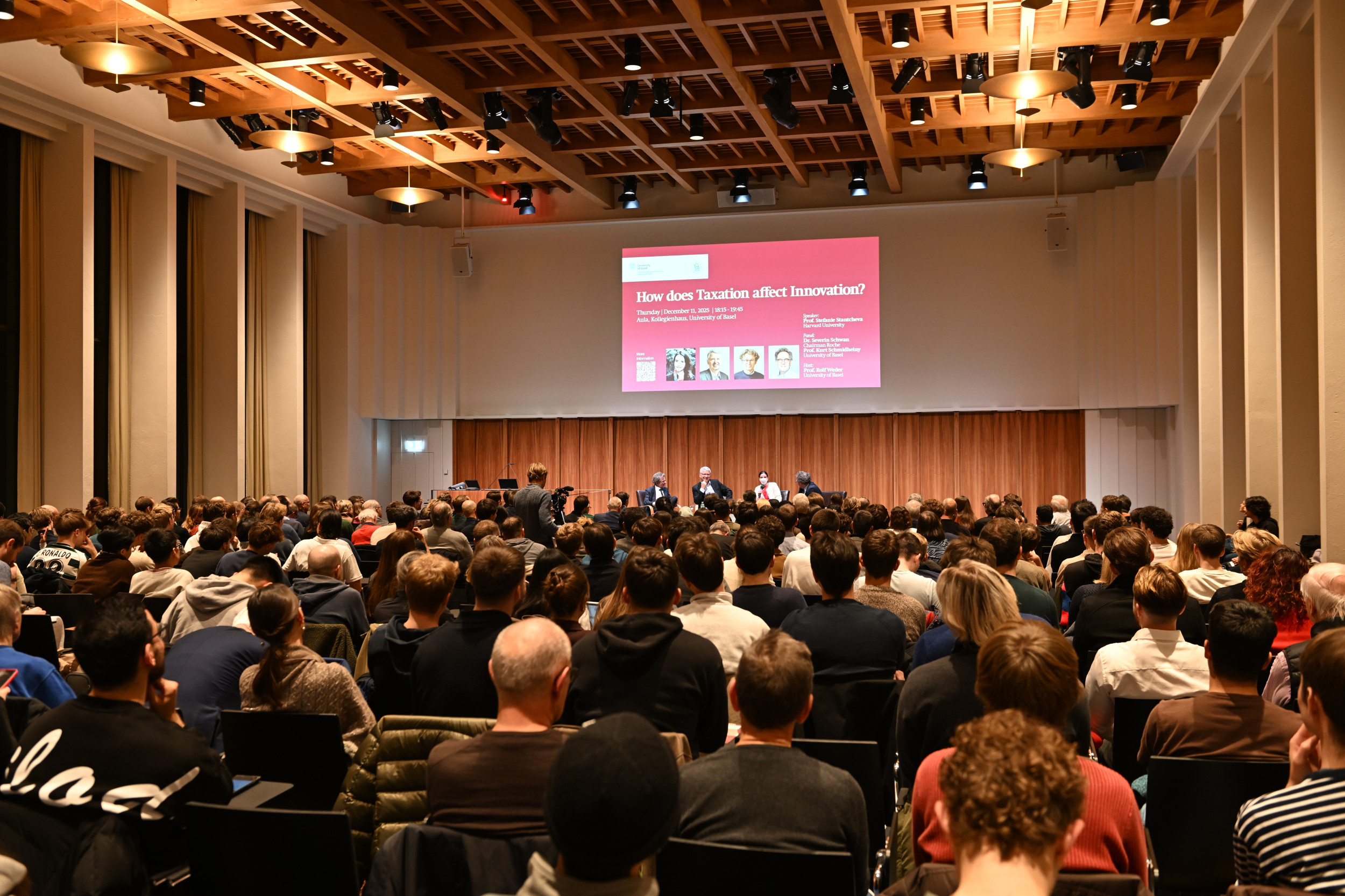
The evening of 11 December 2025 concluded the autumn semester on a high note with the public lecture “Taxation and Innovation: What Can We Learn from Research?”, held as part of the “Innovation in the Global Economy” lecture series. The event took place in the Aula of the University of Basel, which was filled to capacity, reflecting the strong public interest in the relationship between taxation and innovation.
Distinguished guests included Prof. Stefanie Stantcheva (Harvard University), Dr. Severin Schwan, Chairman of Roche, and Prof. Kurt Schmidheiny (University of Basel). The event was hosted by Prof. Rolf Weder (University of Basel).
In his opening remarks, Prof. Rolf Weder emphasized the importance of scientific research in understanding and addressing the challenges posed by globalization. He highlighted the role of the “Innovation in the Global Economy” lecture series as a platform for disseminating cuttingedge academic research to a broader audience, with the aim of stimulating public debate on international technological competition and innovation. Over the years, the series has featured world-renowned economists Philippe Aghion (Nobel Laureate in Economics), Gene Grossman, Pol Antràs, Dave Donaldson and Brad Jensen.
Presentation by Prof. Stefanie Stantcheva
Prof. Stantcheva began her lecture with a historical perspective, recalling iconic innovators such as Thomas Edison from a time when innovation was largely individual-driven and government regulation was minimal. She emphasized that both the legislative framework and the role of taxation have expanded significantly since then, with taxation now serving as a key policy instrument for governments to encourage or discourage innovative activity.
A central theme of her presentation was the institutionalization of innovation. The era of “garage innovation” has largely given way to innovation within large corporations, making corporate taxation a crucial factor in shaping innovative outcomes.
Prof. Stantcheva highlighted that the decision to innovate is fundamentally an economic one. Empirical evidence shows a strong positive correlation between the impact of patents—measured by citation counts—and inventors’ incomes, providing clear evidence of the importance of economic incentives in driving innovation.
She then discussed public policies available to stimulate innovation, such as targeted tax schemes and investments in education, particularly in STEM fields. These policies can have substantial effects on innovative output. At the same time, she pointed to two major challenges in research on the relationship between taxation and innovation: the lack of sufficiently detailed individual-level data and the difficulty of establishing causal relationships. Her research has proposed creative solutions, including the construction of datasets linking patents to tax records and the use of cross-state tax variation in the United States as a source of causal identification. In a lighter moment, Prof. Stantcheva also mentioned some surprising findings from theliterature, such as evidence suggesting that unmarried inventors tend to be more productive than their married counterparts—an observation that elicited laughter from the audience.
Another important topic addressed was the role of “beggar-thy-neighbour” policies. While such policies can attract highly skilled human capital to the countries that implement them (e.g., Denmark or Ireland), they may have negative consequences for countries that lose talent.
International competition for innovators is intense, and research infrastructure plays a key role in this context. The example of California illustrated how, despite relatively high tax rates, strong infrastructure and local amenities can offset fiscal disadvantages.
Panel Discussion
The panel discussion, chaired by Prof. Rolf Weder, brought together Prof. Stefanie Stantcheva, Dr. Severin Schwan, and Prof. Kurt Schmidheiny. When asked directly how taxation affects innovation, Prof. Stantcheva summarized that while taxes can have a discouraging effect, the efficient use of tax revenues to fund infrastructure, education, and quality of life can mitigate these negative effects. Severin Schwan added that, alongside living and research conditions, net income remains an important factor for scientists and innovators.
Prof. Schmidheiny explained why innovation in Switzerland does not concentrate exclusively in low-tax cantons such as Zug. He argued that agglomeration effects in regions like Basel and Zurich create significant advantages that can outweigh the negative effects of higher taxation. Referring to Roche, Dr. Severin Schwan emphasized that Basel offers unique conditions for cutting-edge research, comparable to only a few global hubs such as Boston, Singapore, or London. He noted the strong competitive pressure from the United States and China, the need for competitive tax arrangements, and the crucial role of leading universities—particularly ETH Zurich and EPFL—in supplying highly specialized talent.
The panelists discussed the pros and cons of the OECD minimum taxes introduced by some countries (such as Switzerland), but not by others (such as the U.S.). Prof. Schmidheiny emphasized that the Standortpaket (Location Promotion Act) at least made it possible that some of the higher taxes can flow back to innovation-intensive companies in the region of Basel.
Prof. Rolf Weder reacted that some of this tax income should, in fact, be used for promoting basic research at the university which was supported by Prof. Stantcheva emphasizing the “public good” characteristics of this research. Dr. Schwan fully agreed, but also questioned the introduction of the OECD minimum tax in a world in which strong competitor countries back out.
The event concluded with a short Q&A session with the audience, followed by an aperitif to which Prof. Rolf Weder invited all participants, providing an informal setting for further discussion.
Dr. Augustin Ignatov, Center for Innovation Economics Basel
University of Basel Faculty of Business and Economics, Peter Merian Weg 6, 4052 Basel, Switzerland.