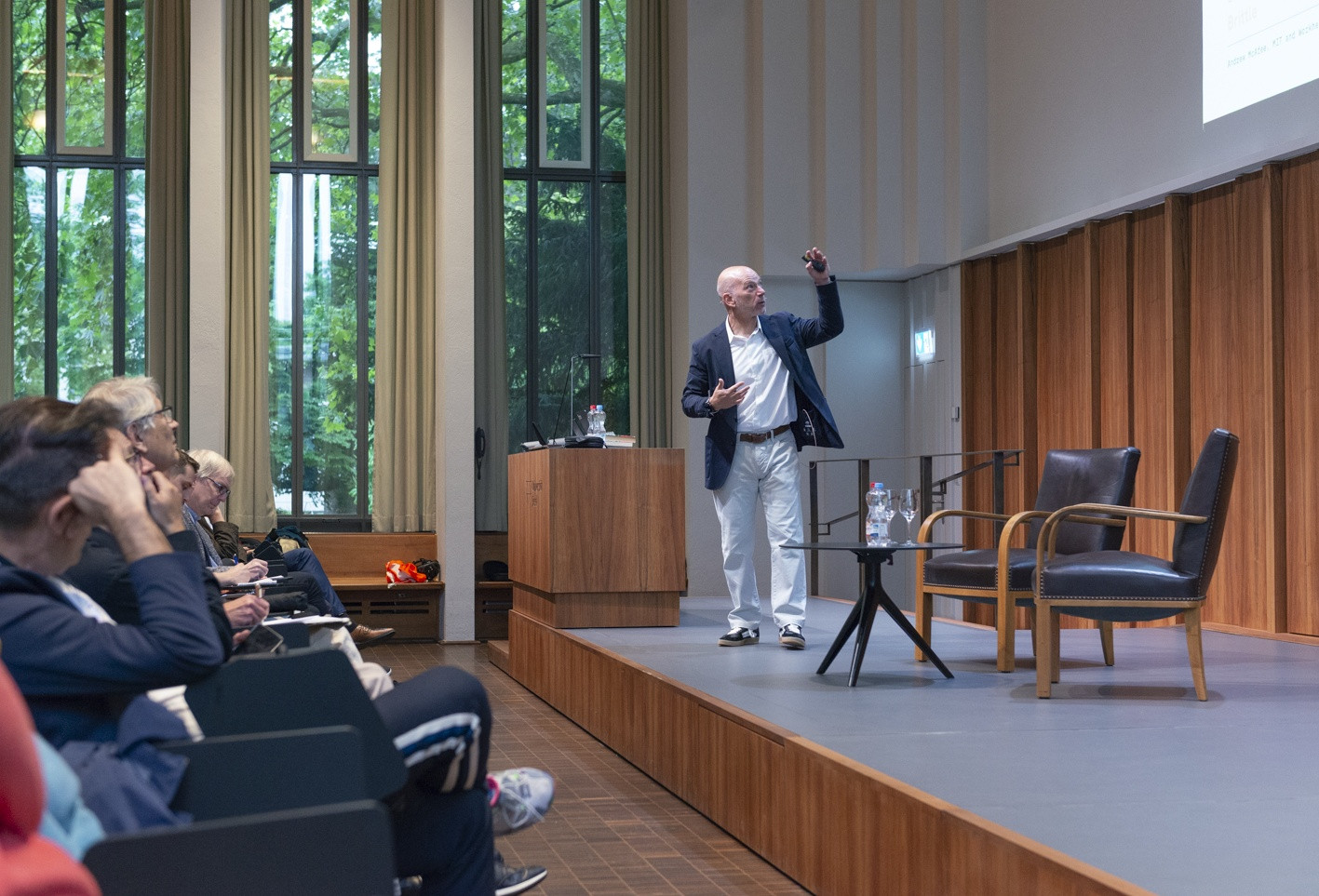
Andrew McAfee | Lecture Series #7
June 2026 by Andrew McAfee and Rolf Weder
The talk is part of the "Lecture Series on Innovation in the Global Economy". The series provides a platform for renowned researchers in Business and Economics to present their research results and thoughts on “Innovation in the Global Economy” to a broad audience. The events tackle the challenges of globalization and new technologies for society, policy makers and companies.
Downloads
260430_McAfee_Flyer.pdfCompetitiveness in the Age of AI
Summary of the Public Lecture on 4 June 2026
On the evening of 4 June 2026, the Aula of the Kollegienhaus at the University of Basel hosted the public lecture “Competitiveness in the Age of AI”, part of the “Innovation in the Global Economy” lecture series organized by the Center for Innovation Economics Basel (CIEB) of the Faculty of Business and Economics. The event drew a large and engaged audience, reflecting the strong public interest in the transformative effects of artificial intelligence on firms and economies.
The speaker was Dr. Andrew McAfee, Principal Research Scientist at the MIT Sloan School of Management and co-founder and co-director of MIT’s Initiative on the Digital Economy. The event was hosted by Prof. Rolf Weder, Professor of International Economics at the University of Basel and head of the CIEB.
Opening Remarks by Prof. Rolf Weder
In his opening remarks, Prof. Rolf Weder underscored the importance of understanding how firms can navigate the dual challenge of technological disruption and global competition. He highlighted the role of the “Innovation in the Global Economy” lecture series as a platform for bringing cutting-edge academic research to a broad audience, with the aim of stimulating informed public and policy debate. He noted that the series has over the years featured world-renowned economists including Philippe Aghion, Gene Grossman, Pol Antràs, Dave Donaldson, Brad Jensen, and most recently, Stefanie Stantcheva (Harvard University, December 2025). Prof. Weder then introduced the speaker and set the context for the evening’s discussion.
Lecture by Dr. Andrew McAfee
Background: Why AI Matters for Firms
Dr. McAfee opened by situating artificial intelligence within the broader history of technological change, drawing on themes explored in his books The Second Machine Age (with Erik Brynjolfsson, 2014) and More from Less. He argued that the current wave of AI — especially generative AI — represents a qualitatively new form of technological capability, one that encroaches not only on routine physical and cognitive tasks but increasingly on creative, analytical, and managerial work. Unlike previous technologies, AI is broadly applicable across sectors and functions, making it a general-purpose technology with the potential to reshape entire economies.
He presented evidence that firms which adopt AI effectively tend to outperform their peers on productivity, innovation, and profitability. Yet the gap between leaders and laggards is widening: many firms — particularly in Europe — struggle to translate AI investment into measurable performance gains. The key question, he argued, is not whether to adopt AI, but how.
The Geek Way: Culture as a Competitive Advantage
The central argument of the lecture drew directly from Dr. McAfee’s most recent book, The Geek Way: The Radical Mindset That Drives Extraordinary Results (2023), named one of The Economist’s Best Books of 2023 and described by former Google CEO Eric Schmidt as “a Handbook for Disruptors”. McAfee argued that the most successful technology companies — those he terms “geek firms” — share a distinctive organizational culture built around four core norms: science, ownership, speed, and openness.
Science
High-performing firms treat business decisions as experiments. Rather than relying solely on intuition or hierarchy, they rigorously test hypotheses, measure outcomes, and revise strategies based on evidence. This scientific mindset allows them to learn faster and make better decisions, particularly under uncertainty.
Ownership
Rather than managing through detailed instructions and hierarchical approval, geek firms empower small, autonomous teams with clear goals and broad discretion. This fosters accountability, initiative, and entrepreneurial behavior within the firm. Individual contributors are expected to act as owners, not just employees.
Speed
The ability to move quickly — to iterate, ship, and learn — is treated as a core strategic asset. These firms reduce bureaucracy and approval layers, enabling rapid cycles of experimentation and feedback. Speed is not an accident but the deliberate outcome of organizational design choices.
Openness
Geek firms cultivate a culture of intellectual honesty and candid debate. Disagreement is encouraged, and bad news travels fast — upward as well as laterally. This openness allows problems to surface and be resolved quickly, preventing the organizational “immune responses” that suppress innovation in more traditional firms.
The European Challenge
Dr. McAfee acknowledged that many highly successful European firms face a particular challenge in adopting AI. Their competitive advantage has historically rested on deep operational expertise, long-standing client relationships, precision engineering, and organizational stability. These very strengths, however, can become liabilities when confronted with technologies that reward speed, experimentation, and radical re-engineering of processes.
He stressed that the obstacle is rarely technical. Most firms can purchase access to AI tools. The deeper challenge is cultural and organizational: how to maintain the discipline, trust, and routines that have made them successful while simultaneously cultivating the openness, speed, and scientific mindset that effective AI adoption demands. This tension, he argued, is the central management challenge of our time.
Practical Implications for Firms
Drawing on his experience advising organizations ranging from the IMF to Fortune 500 companies — and as founder of the generative AI company Workhelix — McAfee offered practical guidance for firms seeking to navigate this transition. He emphasized the importance of starting with use cases where AI can demonstrably add value, building internal AI literacy at all levels of the organization, and creating structures that allow teams to experiment without excessive risk. Leadership, he argued, must model the scientific mindset: being willing to be wrong, to update beliefs, and to reward learning over performance theater.
Discussion
The lecture was followed by a lively discussion moderated by Prof. Rolf Weder, involving both the speaker and the audience. Several recurring themes emerged.
On the question of whether European firms can realistically adopt a “geek culture” without losing their identity, Dr. McAfee was cautiously optimistic. He noted that culture is not fixed, and that firms in sectors as diverse as healthcare, financial services, and manufacturing have successfully transformed their operating models by combining the discipline of their core business with geek norms at the margins, gradually expanding these practices as trust and confidence build.
Questions from the audience touched on the risks of AI — including concerns about workforce displacement, concentration of market power among large technology firms, and the governance of AI systems. Dr. McAfee acknowledged these as legitimate concerns while arguing that the risks of non-adoption — falling behind in productivity and competitiveness — are at least as great as the risks of adoption. He emphasized that the policy environment, including investment in education, research infrastructure, and regulatory frameworks, would be critical in shaping the distribution of AI’s benefits.
The discussion also touched on Switzerland’s specific situation: a small, highly specialized, export-oriented economy with world-class universities, a strong industrial base, and a tradition of precision and quality. Prof. Weder and Dr. McAfee agreed that Switzerland’s research infrastructure — particularly ETH Zurich and EPFL — represents a significant asset in the AI transition, and that the challenge lies in channeling this scientific capacity more effectively into industrial application.
Closing Remarks
Prof. Weder closed the formal session by thanking Dr. McAfee for a stimulating and accessible lecture, and the audience for their engaged participation. He expressed gratitude to the Claudine and Hans-Heiner Zaeslin-Bustany-Foundation for its generous support of the lecture series. Participants were then invited to an apéro, which provided an informal setting for continued conversation between the speaker, the hosts, and the audience.
Dr. Augustin Ignatov, Center for Innovation Economics Basel
University of Basel Faculty of Business and Economics, Peter Merian Weg 6, 4052 Basel, Switzerland.